
Screws & Nails: The Complete Fastener Guide for Every Project
Choosing the right fastener is one of the most overlooked decisions in any build. The wrong screw can split a board, strip its head, or fail under load. This guide breaks down screw and nail types, materials, sizes, and real-world applications so you can select the right fastener with confidence on every project.
Why Fastener Selection Matters
Fasteners are the connective tissue of nearly every home improvement project. A deck that holds for decades, a cabinet that stays square, and a picture frame that hangs straight all depend on choosing the right screw or nail for the material and load. In professional construction, fastener specification is treated as an engineering decision — and for good reason.
Fasteners fail in two primary ways: withdrawal (being pulled straight out) and shear (being cut sideways). Screws excel at resisting withdrawal thanks to their threads, while nails perform better under shear forces because their smooth shanks flex rather than snap. Understanding this distinction is the foundation of smart fastener selection.
If you are new to tools and materials, start with our tool basics guide and then return here to fine-tune your fastener knowledge. For projects that involve structural changes, always consult a licensed contractor — our guide to structural repairs explains when professional input is essential.
Common Screw Types and Their Best Uses
Screws are the workhorses of modern DIY. They hold tightly, are removable, and come in a bewildering variety of shapes. Here are the types you will encounter most often.
Wood Screws
Wood screws feature a smooth upper shank and a threaded lower portion. The unthreaded shank allows the top board to pull tight against the lower one. They are the default choice for furniture assembly, cabinet installation, and general wood-to-wood fastening. For most indoor furniture builds, mid-range wood screws with coarse threads offer an excellent balance of grip and ease of driving.
Drywall Screws
These have fine threads and a bugle-shaped head that sinks flush without tearing the paper face of drywall. They are essential for hanging drywall and are also useful for light-duty assembly. Our drywall installation guide covers screw spacing and depth in detail.
Deck Screws
Coated or stainless deck screws resist corrosion and feature a self-countersinking head. They are designed for outdoor lumber and are the standard for deck building. When working with treated lumber, always pair deck screws with the correct coating — plain steel will rust quickly.
Lag Screws
Heavy-duty lag screws (sometimes called lag bolts) have hex heads and coarse threads. They are used to fasten heavy timbers, attach ledger boards to house framing, and secure structural connections. These are professional-grade fasteners that demand pilot holes and, in many jurisdictions, engineered plans.
Sheet Metal Screws
With sharp, fine threads and a pointed tip, sheet metal screws cut their own path through thin metal. They are also handy for attaching hardware to metal studs and for light HVAC work.
Concrete Screws
These specialized screws anchor directly into masonry without a plastic plug. They are a convenient option for attaching furring strips, brackets, and fixtures to concrete or brick. If your project involves foundation-level work, review our basement waterproofing resource before you drill.
| Screw Type | Best For | Typical Tier |
|---|---|---|
| Wood Screw | Furniture, cabinets, general wood assembly | Essential to mid-range |
| Drywall Screw | Hanging drywall, light assembly | Entry-level |
| Deck Screw | Outdoor decks, treated lumber, fencing | Mid-range to premium |
| Lag Screw | Heavy timber, structural connections | Professional-grade |
| Sheet Metal Screw | Thin metal, HVAC, metal studs | Entry-level |
| Concrete Screw | Masonry anchors, furring strips | Mid-range |
Common Nail Types and Their Best Uses
Nails are faster to install, stronger in shear, and less likely to split certain woods when driven correctly. They are the backbone of framing and trim work.
Common Nails
Common nails have a large, flat head and a smooth shank. They are the standard for rough framing — wall studs, joists, and sheathing. Their shear strength is excellent, which is why structural codes specify them for load-bearing connections.
Box Nails
Box nails are thinner than common nails and have a smaller head. They are used for lighter framing and where splitting is a concern. They are a sensible entry-level choice for small sheds and non-structural assemblies.
Finishing Nails
Finishing nails have a tiny, slightly cupped head that can be set below the wood surface with a nail set. They are the go-to for trim, baseboard, and cabinet molding where appearance matters. Pair them with wood filler for an invisible finish.
Brad Nails
Brad nails are very thin and are typically driven with a pneumatic or electric brad nailer. They are ideal for delicate trim, beadboard, and small moldings. Their holding power is modest, so avoid them where the joint will be stressed.
Roofing Nails
Roofing nails feature a wide head and a barbed or twisted shank. They are designed to hold shingles and underlayment securely. For roof-related repairs, see our roof repair guide for safe practices and material matching.
Duplex Nails
Duplex nails have two heads, allowing them to be driven and later removed easily. They are used for temporary formwork and scaffolding. They are a starter tier specialty fastener, not intended for permanent construction.
| Nail Type | Best For | Typical Tier |
|---|---|---|
| Common Nail | Structural framing, joists, sheathing | Essential tier |
| Box Nail | Light framing, splitting-prone wood | Entry-level |
| Finishing Nail | Trim, baseboard, cabinet molding | Mid-range |
| Brad Nail | Delicate trim, beadboard, small moldings | Entry-level |
| Roofing Nail | Shingles, underlayment | Mid-range |
| Duplex Nail | Temporary formwork, scaffolding | Starter tier |
Fastener Materials: Steel, Coating, and Corrosion
The base metal and coating of a fastener determine how long it will last in its environment. Indoor projects are forgiving, but outdoor and treated-lumber applications demand careful material matching.
Standard Steel
Bright or zinc-plated steel fasteners are the most common and are perfectly suitable for interior, dry applications. They are an essential tier option for furniture, cabinets, and interior trim.
Hot-Dipped Galvanized
Hot-dipped galvanized (HDG) fasteners have a thick zinc coating that provides strong corrosion resistance. They are the minimum standard for exterior decks, fences, and treated lumber. This is a mid-tier specification that most outdoor projects should adopt.
Stainless Steel
Stainless steel fasteners offer the highest corrosion resistance and are recommended for coastal environments, cedar and redwood decks, and any application where staining from corrosion is unacceptable. This is a premium material choice that pays off as a long-term investment in durability.
Critical compatibility note: Pressure-treated lumber is treated with copper-based preservatives that aggressively corrode standard steel. Always use hot-dipped galvanized or stainless steel fasteners rated for treated lumber. Mixing incompatible metals can cause premature failure in a single season.
For any outdoor build, review our deck building plans and fence installation guides, both of which specify corrosion-resistant fasteners as a baseline requirement. If rust is already a problem on existing hardware, see our rust removal guide before replacing fasteners.
How to Choose the Right Fastener Size
Sizing is where many DIYers go wrong. A screw that is too short will not hold; a nail that is too long will split the board or poke through the finished face.
The Half-Thickness Rule for Screws
For fastening two boards together, the screw should penetrate the lower board by at least half the thickness of the upper board. For example, attaching a 3/4-inch board to another 3/4-inch board calls for a screw around 1-1/4 to 1-5/8 inches long. This rule ensures enough thread engagement without over-penetration.
Nail Length and Penetration
For framing, a common rule is that the nail should penetrate the receiving member by at least 1-1/2 inches. Structural codes often specify exact nail lengths and counts, so consult your local building authority before framing a wall or attaching a ledger.
Gauge and Diameter
Screw gauge (often #6, #8, #10, #12) describes shank diameter. Larger gauges are stronger but require larger pilot holes. Nail sizing uses pennies (e.g., 8d, 10d, 16d), which historically referred to a reference quantity. As a practical guide, 8d nails suit trim and light framing, 10d suits general framing, and 16d suits heavy framing and ledgers.
Pro tip: Always drill a pilot hole in hardwood, near board edges, and whenever using large-gauge screws. A pilot hole slightly smaller than the screw's minor diameter prevents splitting while preserving holding power. For a deeper dive into tool selection, see our tool basics resource.
Screws vs. Nails: A Practical Decision Framework
The screws-versus-nails debate is settled by three questions: What forces will the joint face? Will the joint ever need to come apart? How much time do you have?
- Choose screws when: you need high withdrawal resistance, the joint may be disassembled, you are fastening hardware or cabinets, or you want to control clamping force.
- Choose nails when: you need high shear strength, speed of installation matters, you are framing or attaching trim, or you are working with a nail gun on repetitive tasks.
- Use both when: a structural connection benefits from a combination — for example, construction adhesive plus screws for cabinets, or nails for shear plus structural screws for withdrawal in certain built-up beams (always per engineering guidance).
For larger renovation projects that involve framing changes, our renovations hub and remodeling and construction overview provide context on sequencing and code considerations. If your project involves adding a room, see room addition guidance before you finalize fastener schedules.
Fastener Buying Checklist for DIYers
A well-stocked fastener supply saves repeated trips and keeps projects moving. Here is a practical starter list organized by project type.
Essential Tier — Every Home Toolbox
- #8 wood screws in 1-1/4", 1-5/8", and 2" lengths
- #6 drywall screws in 1-1/4" and 1-5/8"
- 8d finishing nails
- Assorted picture hangers and small brads
Mid-Tier — Active DIY Household
- Deck screws in 2", 2-1/2", and 3" lengths (coated)
- #10 wood screws in 2-1/2" and 3"
- 10d and 16d common nails for light framing
- Brad nails for a nail gun if you own one
Top-Tier — Serious Workshop or Renovation
- Stainless steel deck screws for premium outdoor work
- Lag screws and structural screws in multiple lengths
- Concrete screws and masonry anchors
- Roofing nails and specialty trim fasteners
Storage matters as much as selection. Our tool storage ideas and tool storage guides cover bins, organizers, and labeling systems that keep fasteners sorted and accessible.
Fastener Safety and Best Practices
Fasteners are small, but the forces they carry can be large. Respect these fundamentals on every project.
- Wear safety glasses when driving fasteners — heads can shatter or fly.
- Never drive a fastener into a wall without checking for wiring and plumbing. Use a stud finder and, where appropriate, a voltage tester. Our stud finders and voltage testers guides explain how to scan safely.
- Do not over-drive screws; over-torquing strips threads and crushes material.
- Use the correct driver bit. A worn bit cams out and damages the screw head.
- Follow manufacturer and code specifications for structural connections. When in doubt, consult a professional — our safety first guide is a good starting point.
For projects near utilities or structural elements, professional oversight is wise. Our residential structural repair contractors directory can help you find qualified local expertise.
Frequently Asked Questions About Screws and Nails
When should I use screws instead of nails?
Use screws when you need holding power that resists withdrawal, such as attaching cabinets, building decks, or assembling furniture. Screws are also easier to remove. Use nails when speed matters and shear strength is critical, such as framing walls and attaching trim.
What size screw should I use for wood?
A common rule is that the screw should penetrate the second piece of wood by at least half the thickness of the first piece. For a 3/4-inch board fastened to another board, a 1-1/4 to 1-5/8 inch screw is typically appropriate.
Are nails stronger than screws?
It depends on the force. Nails have higher shear strength, meaning they resist sideways forces well, which is why they are used in framing. Screws have higher tensile strength and resist being pulled out, making them better for hanging and fastening loads.
What are the most common screw head types?
The most common screw head types are Phillips, which self-centers but can cam out; Torx, which offers superior grip and reduced stripping; square drive, which provides good control; and hex, commonly used for structural and lag screws.
Do I need special nails for pressure-treated wood?
Yes. Pressure-treated lumber contains corrosive chemicals that will degrade standard steel fasteners. Use hot-dipped galvanized or stainless steel nails and screws rated for treated lumber to prevent rust and premature failure.
Final Thoughts: Build with the Right Fastener
The right fastener is invisible in a finished project but essential to its durability. Match the fastener to the material, the load, and the environment; size it correctly; and respect the code requirements for structural work. With this framework, you can approach any project — from a simple shelf to a full deck — with the confidence that your connections will hold.
If your fastener decisions are part of a larger renovation, explore our renovate house and home renovation resources for planning guidance, or connect with remodeling contractors when structural scope requires professional sign-off.
Top-Rated Screws & Nails for Woodworking and Home Repairs
⚠️ AFFILIATE DISCLOSURE: This website contains affiliate links. As an Amazon Associate, we earn from qualifying purchases. If you make a purchase through these links, we may receive a small commission at no additional cost to you. Read our full affiliate policy.

320Pcs Premium Hardware Nails & High Hardness Wood Screws Assortment Kit, 11 Sizes (1/2"-2"),Phillips Drive Flat Head, Wood Screws, Galvanized, Picture Hanging, Wood, Common Nails with Storage Box
Check price on Amazon
KURUI 350Pc Picture Hanging Nails & Wood Screws Kit, 6 Nail & 6 Screw Sizes | 145 Phillips Flat Head Wood Screws and 205 Assorted Finishing Nails for Hanging, Wall Decor,Clocks,Mirrors & Repair Projects
Check price on Amazon
Wensilon 270PCS Drywall Anchors and Screws Plastic Anchors Assortment Kit | with Screws, Nails, cement screws,Three sizes of drill bits, for Drywall, Wood,brickwall and concrete wall
Check price on Amazon
Ruibapa 1680pcs Nails and Screws Assortment Kit,3/4"-2" Hardware Nails,M3/M4/M5/M6 Machine Screws,#6#8 High Hardness Wood Screws,Assorted Screws, Common Nails with Handheld Box
Check price on Amazon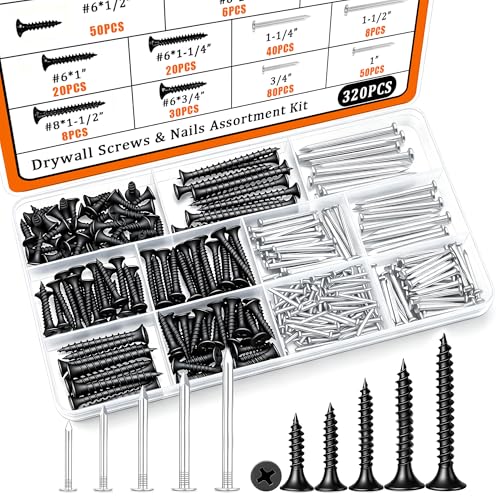
Dianrui Nails & Wood Screws Assortment Kit, 320 PCS #6#8 Philips Black Drywall Screws Set and High Hardness Hardware Small Nails for Picture Hanging/DIY Repair Project Length 1/2" to 2"
Check price on Amazon
Dianrui 1680 PCS Nails and Screws Assortment Kit & Screw Bolts and Nuts, M3/M4/M5/M6 Machine Screws, Small Nails for Picture Hanging, #6#8 Drywall Screw Set for DIY Repair Project Length 1/2" to 2"
Check price on Amazon
Dianrui Nails & Wood Screws Assortment Kit, 320 PCS #6#8 Philips Drywall Screws Set and High Hardness Hardware Small Nails for Picture Hanging/DIY Repair Project Length 1/2" to 2"
Check price on Amazon